
Systems of Service
How Full-Service Restaurants Plan, Operate, and Lead Under Pressure

Plan, operate, and lead one connected service system.
Guests experience one evening. The restaurant creates it through hundreds of linked decisions. Systems of Service brings those decisions together so leaders can diagnose pressure, prepare the shift, coordinate every station, protect the guest promise, and improve the next service.
- 63 chapters in three connected parts
- Restaurant flow, workload, timing, pacing, communication, stations, standards, and recovery
- Demand planning, staffing, capacity, readiness, pre-shift transfer, contingency triggers, handoffs, and closeout
- Signals, human readiness, awareness, anticipation, judgment, emotional control, recovery authority, teamwork, institutional memory, and stewardship
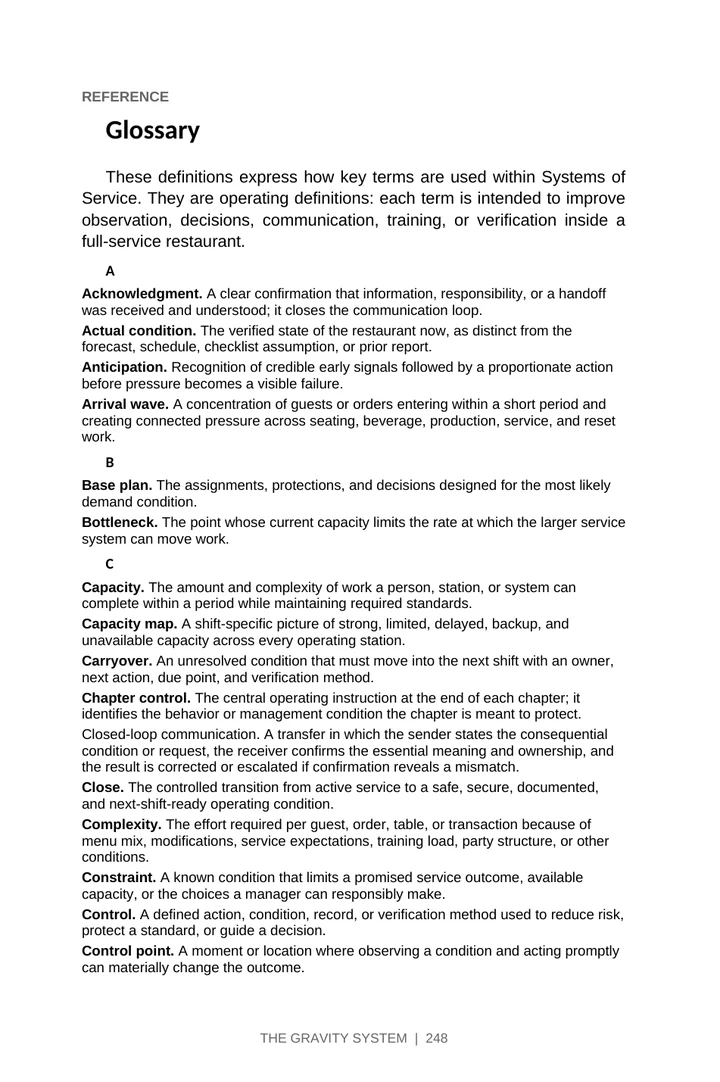
- Nine implementation appendices plus a 60-term glossary
Thomas Butler • Thomas Monroe Books • 253 pages • Gravity Elite v2.0 revised September 11, 2026
No purchase or donation is required. The digital edition is complete; a physical edition is not currently offered.
Understand the system. Plan the shift. Lead beneath the pressure.
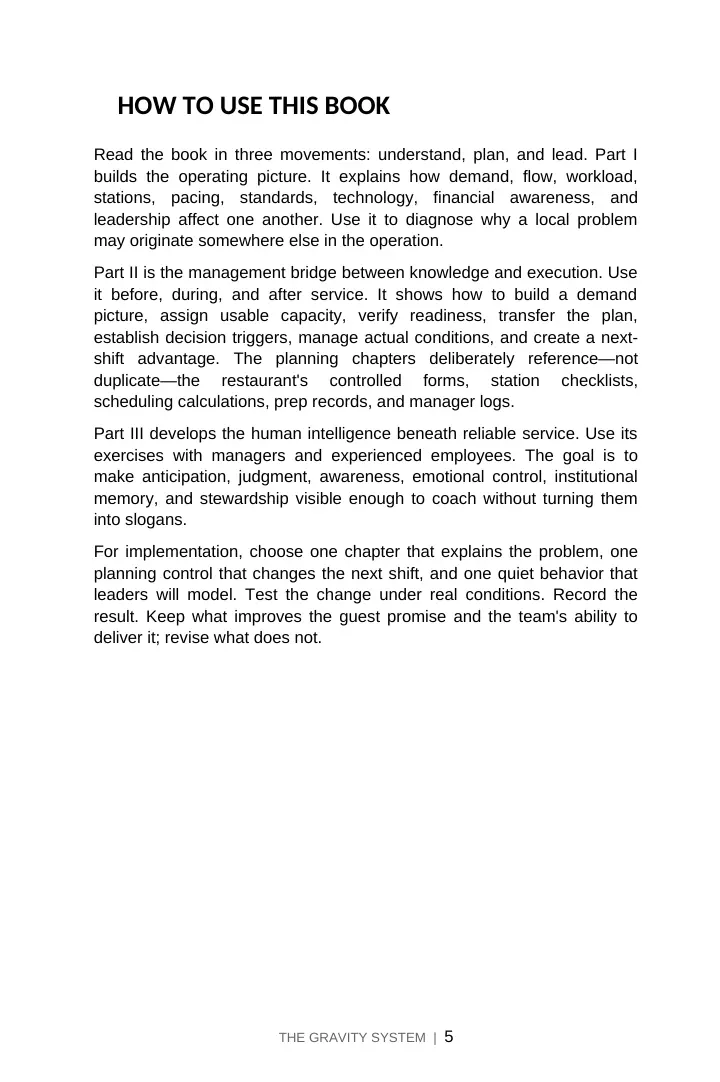
The three parts are intentionally connected. They should be read as one operating model, not as competing books.
Part I — The System of Service
Build the visible operating structure: demand, flow, workload, stations, pacing, communication, technology, standards, leadership, recovery, and continuous improvement.
Part II — Planning for Service
Translate expected demand into a shift the restaurant can execute. Verify capacity and readiness, transfer the plan, establish decision triggers, manage actual conditions, and create a next-shift advantage.
Part III — The Quiet Systems of Service
Develop the signals, human readiness, awareness, anticipation, judgment, emotional control, recovery authority, memory, teamwork, and stewardship that let people adapt without turning pressure into disorder.
Use it where service breaks across departments.
This is not a server script or a list of hospitality slogans. It is an operating book for owners, general managers, assistant managers, service leaders, kitchen leaders, trainers, hosts, servers, bartenders, and anyone responsible for coordinating a live shift.
- Reservation waves overload sections or kitchen capacity.
- Pre-shift meetings transfer information without transferring a usable plan.
- FOH and BOH solve the same pressure separately.
- Recovery depends on heroics instead of clear authority.
- Closing records what happened but does not improve the next shift.
Change one real shift before expanding.
Choose one chapter that explains the pressure, one planning control that changes the next shift, and one quiet behavior leaders will model. Test the combination under real conditions, record the result, and keep only what improves execution and the guest promise.
Use the Station Pre-Shift Checklist Open the Shift Handoff LogMove the service system from reading to shift use.
The Fulfillment implementation kit separates reusable planning and handoff pages, audit and debrief controls, and pressure-scenario training into focused working packs.
Look inside Systems of Service
These are actual pages from the current 253-page Gravity Elite v2.0 flagship edition.

The complete book remains available through October 1, 2027 as part of the Founding Year.
Systems of Service FAQ
Is this one book or three books?
One book. The System of Service, Planning for Service, and The Quiet Systems of Service are the three parts of a single 253-page Gravity Elite flagship.
Does it include practical planning?
Yes. Part II covers demand, staffing, skill mix, every-station capacity, readiness, pre-shift meetings, contingency triggers, live plan management, handoffs, closing, and next-shift planning.
Who should read it?
Owners and managers should lead with it, then use selected chapters with service, kitchen, bar, host, expo, prep, and support teams when the material matches their role.
Can I order a physical copy?
Not yet. The complete digital PDF is available now. The Fulfillment Center will list a physical edition only after production, pricing, ordering, and delivery are genuinely ready.