Standards & Accountability
The Gravity System helps restaurants move from informal expectations to standards that are written, taught, measured, and protected.
The answer only matters if the restaurant lives by it.
Once the solution is clear, the solution becomes the standard. That is where real operational change begins.
| Old pattern | Gravity Standard |
|---|---|
| Repeated conversations with no proof of change. | Written expectations, follow-up records, and review dates. |
| Employees learn different standards from different trainers. | Training checklists, SOPs, sign-offs, and consistent task expectations. |
| Managers react emotionally after the problem appears. | Pre-shift planning, manager tools, and fair documentation. |
| Labor, waste, and service problems are discussed from memory. | Labor review, waste logs, POS reports, complaint patterns, and weekly review. |
| Employee policies are unclear or inconsistently enforced. | Practical, fair employee standards that can be reviewed, taught, customized, and used consistently. |
Employee standards belong in the system.
A restaurant cannot claim a higher standard while leaving daily conduct unclear. Attendance, meals, beverages, phones, discounts, respect, documentation, and corrective action all need a practical framework.
This framework should be reviewed and customized by the owner before being adopted as official restaurant policy.
Fair accountability is not harsh accountability.
Fair accountability means the expectations are clear, the training is documented, the follow-up is consistent, and the manager is not correcting one employee by a different standard than another.
- Clear enough to explain.
- Practical enough to use.
- Consistent enough to apply fairly.
- Measured enough to improve.
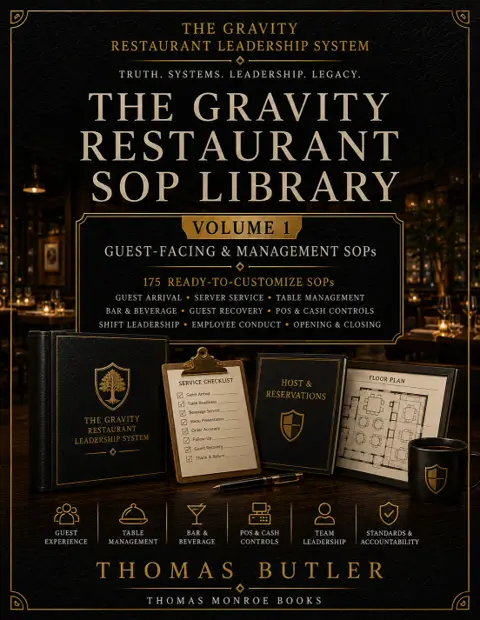
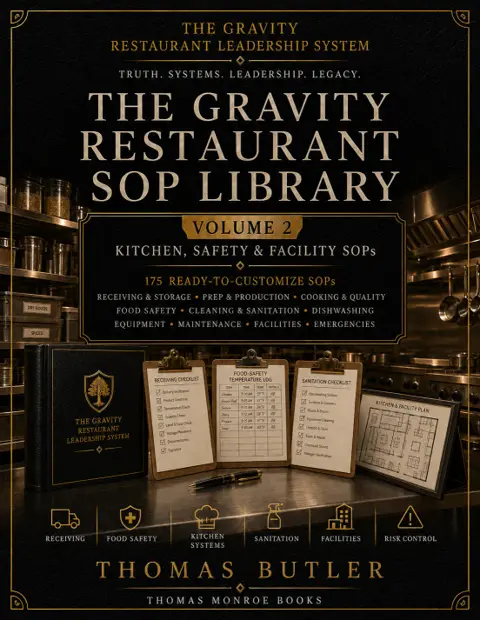
Turn approved standards into trainable procedures.
The two-volume SOP Library gives restaurant leaders 350 practical procedures. Each includes implementation steps, manager verification, customization fields, and employee sign-off.
Restaurant SOP & Station Operations Builder teaches the SOP system. The Gravity Restaurant SOP Library supplies the procedures.
View the Standards LibraryPractical. Fair. Clear. Consistent.
The employee standards workbook is designed as a practical framework, not legal advice. Owners should review and adapt employee policies for their specific restaurant, state, and employment requirements before adoption.